

The front suspension rebuild begins...
The new year has seen a focus on the front suspension. The plan was to get the car back on four wheels, to enable it to be manoeuvrable. This is important as the next milestone ahead of us is the bodyshell respray. Moving a bodyshell without wheels is much more difficult and requires extra money spent on wheeled frames etc.
With the beautiful, re-painted engine frames fitted to the bulkhead, the front suspension reconstruction could begin.
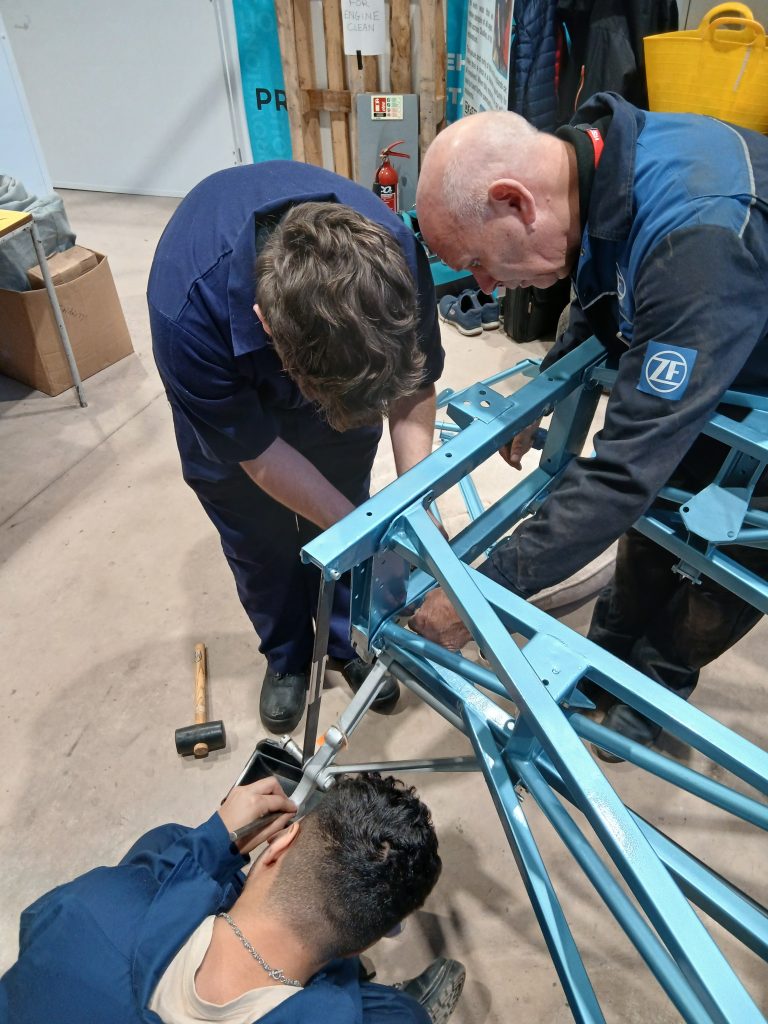
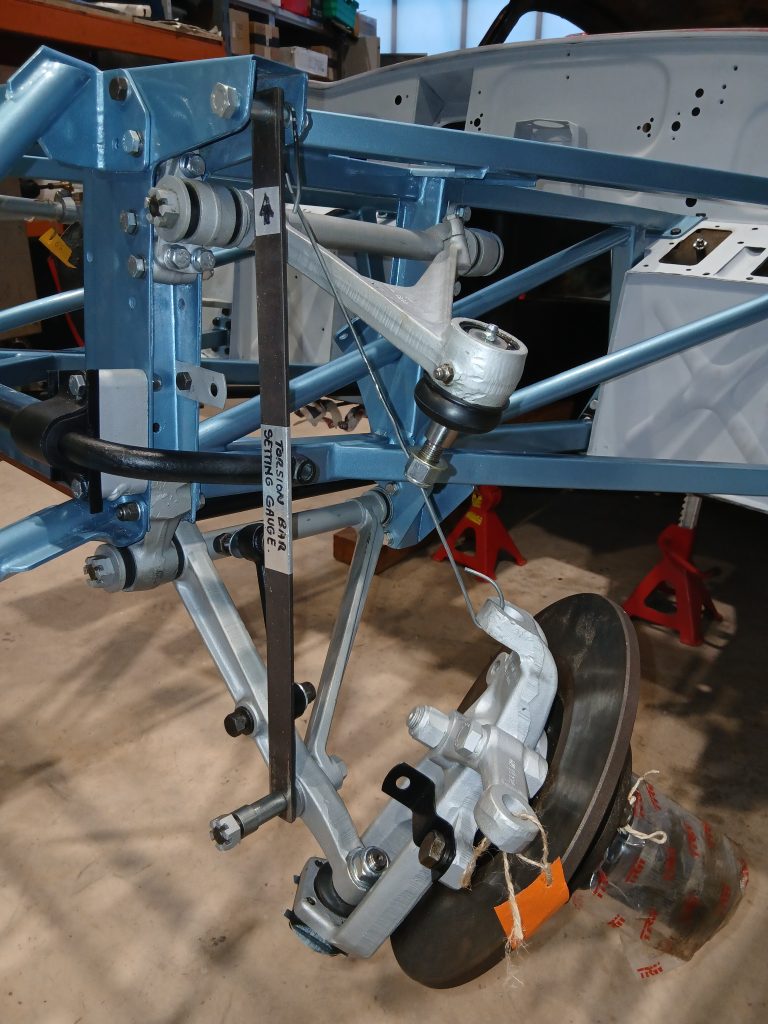
Once again, we had great help from the Dudley College level 3 students. This presented a very different experience from their normal mechanical tasks. In the photo opposite they are installing the near side lower wishbone and torsion bar. Notice the steel bar inserted into the damper location (made to manual specifications). This is the torsion bar setting gauge. It holds the lower wishbone in the correct position for zero torsion energy. The torsion bar is then rotated until the splines and reaction plate anchor points line up correctly. This process insures that the car, when fully loaded, sits at the correct ride hight. It requires a lot of trial and error but suddenly you find everything lines up. The students show great patience and determination with this process.
Provision House (the charity behind this project) has been facing considerable financial strain over the last few months and so the amount of time Nick Gainsford (project manager) has been able to give has been reduced to one day a week. This has meant progress has been slow, but with the college students help on Wednesday’s, we have still achieved a lot, as you can see.
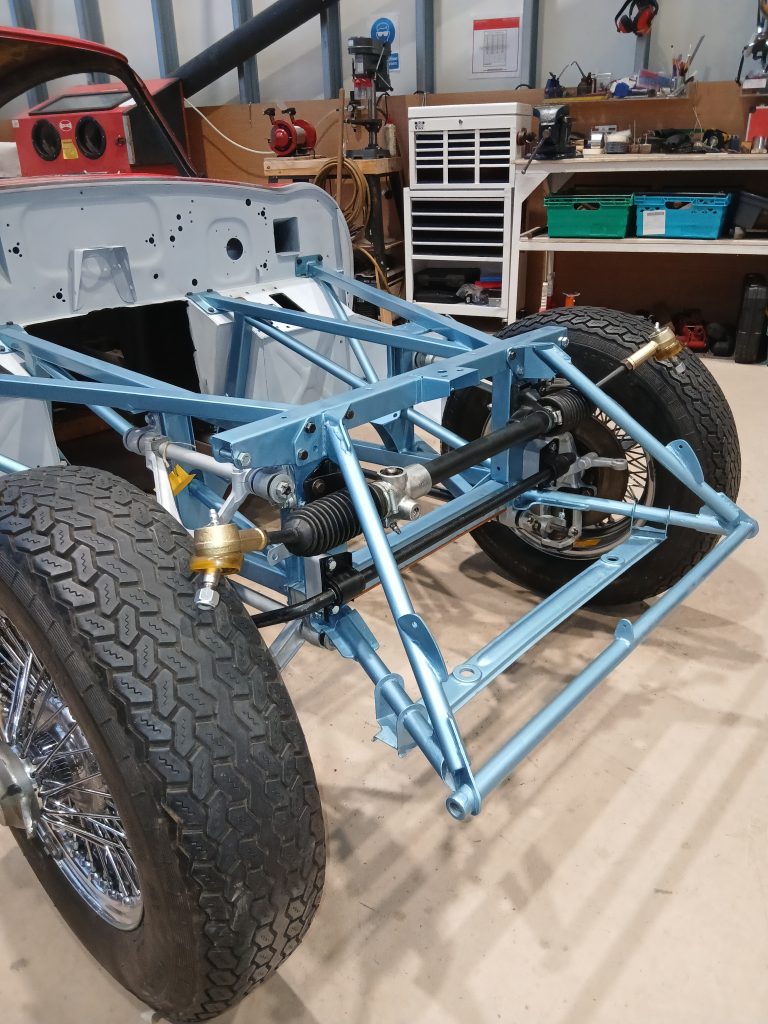
Last year, considerable time was spent restoring the suspension parts, blasting and refinishing, as well as replacing bushes and ball joints. You can clearly see the results in the photo opposite. Don’t they look great!
Everyone involved, students and volunteer team alike, have really enjoyed this task. But, what a jigsaw puzzel it has been finding the right locations for each nut and bolt! Whilst the bolts are nearly all the same nut and thread size, they are in four different lengths, ranging from 2 1/2 inch to 4 inch. Each bolt having a specific location. We had carefully bagged and labelled everything when we originally removed them, but there was still plenty of head scratching, trial and error involved.
Nearly every bolt around the ‘picture frame’ section has a multiple purpose. For example, a bolt may not just be fixing the bonnet frame to the ‘picture frame’, it also secures a suspension fulcrum block as it passes through various holes and frame cavities. This means that every aspect of the front suspension and engine frame must be assembled together and in the correct order. If this is not done, you inevitably have to deconstruct what you have just assembled in order to include an essential part. Yes, we had to do this a number of times before we got it right!
Next we connected the upper wishbone ball joints to the top of the uprights on each side of the car. The uprights carry the disc rotors and splined wheel hubs.
We put the wheels and spinners on before lowering the car onto the floor again. It was at this stage that we realised, with no weight on the front end (i.e. no engine, gearbox or ancillary etc), there was nothing to compress the suspension, being held in its fully ‘drooped’ position by the torsion bars. The result of this fully lowered suspension position, was that there was no way of installing the dampers (shock absorbers), as they would not extend this far. In addition it also puts the track rod ends almost out of reach of their locations.
So, the order in which we have done things, basically means that we will have to wait for the engine etc, before we can proceed with the connection of these parts.
From further research into correct torque settings for the front end, I have discovered a tightening procedure / sequence for the engine frames. We currently have everything hand tight, as we plan to detach the frames from the bulkhead again prior to painting, in order be able to paint the bulkhead unobstructed. It is only after refitting once again, and relaxing every bolted joint, that we will observe the re-tightening sequence and torque settings properly.
This whole project is an amazing journey of discovery for all concerned and a total privilege.
We write rarely, but only the best content.
Please check your email for a confirmation email.
Only once you've confirmed your email will you be subscribed to our newsletter.
